If you’ve ever searched for ways to fix yellow leaves, weak blooms, or slow-growing plants, you’ve probably come across advice suggesting Epsom salt. Some gardeners swear by it. Others say it’s overrated. And many try it without really knowing what it does.
That confusion is understandable.
Epsom salt for plants has been passed down through gardening forums, neighbor advice, and old-school growing tips for years. But not all of that advice is accurate or safe for every garden.
This article takes a grounded, evidence-based approach. Instead of hype or blanket recommendations, we’ll look closely at what Epsom salt actually does for plants, when it can help, when it won’t, and how to use it responsibly without throwing your soil out of balance.
What Is Epsom Salt (And What It Isn’t)
Despite the name, Epsom salt isn’t salt in the way table salt is. It doesn’t contain sodium, and it has nothing to do with seasoning food.
Epsom salt is magnesium sulfate, a naturally occurring mineral compound made up of:
- Magnesium
- Sulfur
- Oxygen
Both magnesium and sulfur are nutrients plants need but only in specific amounts. That’s an important detail many gardening tips leave out.
Epsom salts for plants are best understood as a corrective supplement, not a fertilizer and not a cure-all.
Is Epsom Salt Good for Plants?
The honest answer is: it depends on your soil and your plant’s needs.
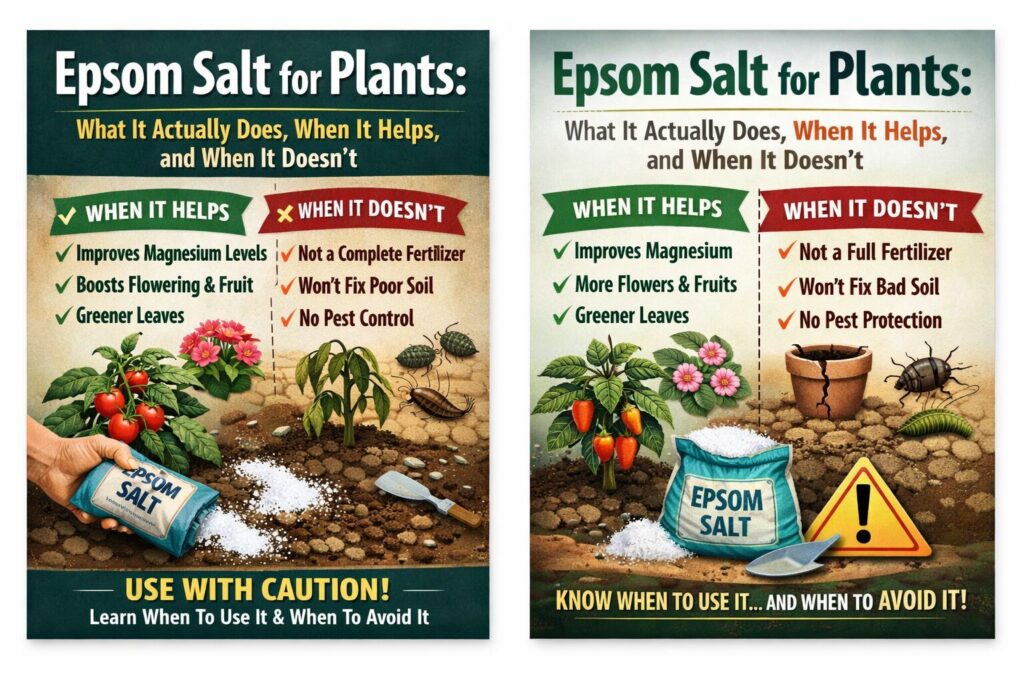
Epsom salt is good for plants only when magnesium levels are low. In those cases, it can be helpful, sometimes noticeably so. Leaves may green up, growth may improve, and flowering plants can recover.
But if your soil already contains adequate magnesium, adding more won’t improve plant health. In fact, it can interfere with calcium uptake and create new problems.
That’s why many extension services and soil specialists recommend testing soil before applying Epsom salt regularly.
What Does Epsom Salt Do for Plants?
When used appropriately, Epsom salt supports plants in a few specific ways.
It Supports Chlorophyll Production
Magnesium sits at the center of the chlorophyll molecule. Without enough of it, plants struggle to photosynthesize efficiently. This often shows up as yellowing between leaf veins.
It Helps With Nutrient Uptake
Magnesium plays a role in how plants absorb and use other nutrients, including nitrogen and phosphorus. When magnesium is deficient, fertilizer alone may not solve the problem.
It Can Improve Flower and Fruit Development
Sulfur contributes to enzyme activity and protein formation. In some flowering and fruiting plants, this can support better performance again, only when a deficiency exists.
This explains why people often ask what does Epsom salt do for plants because when it works, the results can be noticeable.
Epsom Salt for Tomato Plants: What Gardeners Get Wrong
Tomatoes are frequently mentioned in discussions about Epsom salt, and for good reason they’re sensitive to nutrient imbalances.
When Epsom Salt Helps Tomatoes
- Magnesium deficiency symptoms are present
- Leaves show interveinal yellowing
- Growth slows despite proper feeding
In these cases, epsom salt for tomato plants may help restore balance.
When It Doesn’t
Epsom salt does not prevent blossom end rot. That condition is caused by calcium deficiency and inconsistent watering not magnesium.
Using Epsom salt for tomatoes planting without understanding this often leads to disappointment.
Epsom Salt for Rose Plant Health
Roses are another plant commonly associated with Epsom salt use.
Gardeners often report:
- Deeper green leaves
- Improved bloom production
- Stronger-looking plants
These results usually appear when roses are grown in magnesium-poor soil. Epsom salt for rose plant care should be used sparingly and alongside proper fertilization, not instead of it.
How Much Epsom Salt for Plants Is Safe?
Dosage matters more than most people realize.
General Usage Guidelines
| Application | Amount |
| Soil application | 1 tablespoon per foot of plant height |
| Foliar spray | 1 tablespoon per gallon of water |
| Potted plants | ½ tablespoon per gallon |
More is not better. Overuse can:
- Disrupt nutrient balance
- Reduce calcium availability
- Stress soil microorganisms
If you’re unsure, start small or don’t apply at all until deficiency is confirmed.
View More: Himalayan Salt Room Benefits
Best Ways to Apply Epsom Salts for Plants
Soil Application
Sprinkle around the base of the plant and water thoroughly. This method works slowly and is best for long-term correction.
Foliar Spray
Spraying diluted Epsom salt on leaves allows faster magnesium absorption. This is often used for quick correction but should not be frequent.
During Transplanting
Some gardeners use small amounts during transplanting, but this should only be done when magnesium deficiency is known.
When You Should NOT Use Epsom Salt
Avoid using Epsom salt if:
- Soil tests show adequate magnesium
- Plants show calcium or iron deficiency
- It’s being used repeatedly without results
Many plant issues look similar on the surface. Adding minerals blindly can make the real problem harder to fix.
Common Myths About Epsom Salt in Gardening
“Epsom salt works for every plant.”
It doesn’t. Only magnesium-deficient plants benefit.
“It replaces fertilizer.”
Epsom salt contains no nitrogen, phosphorus, or potassium.
“It fixes yellow leaves instantly.”
Yellowing has many causes. Magnesium is just one of them.
Environmental and Soil Health Considerations
Used responsibly, Epsom salt has minimal environmental impact. Overused, it can contribute to nutrient runoff and long-term soil imbalance.
Healthy soil depends on balance, not constant intervention.
Conclusion: Should You Use Epsom Salt for Plants?
Epsom salt for plants isn’t a miracle solution but it isn’t useless either.
When used thoughtfully and for the right reason, it can correct magnesium deficiencies and support healthier growth. When used blindly, it often creates new problems instead of solving old ones.
If there’s one takeaway, it’s this: Epsom salt works best when guided by observation, moderation, and soil awareness not guesswork.
FAQs About Epsom Salt for Plants
Is epsom salt good for plants overall?
Only when magnesium deficiency exists.
What does epsom salt do for plants exactly?
It supplies magnesium and sulfur, supporting photosynthesis and nutrient use.
How much epsom salt for plants should I use?
Typically 1 tablespoon per gallon for foliar spray or soil application.
Can I use epsom salt for tomato plants regularly?
Only if magnesium deficiency is present.
Can epsom salt harm plants?
Yes, if overused or applied unnecessarily.