
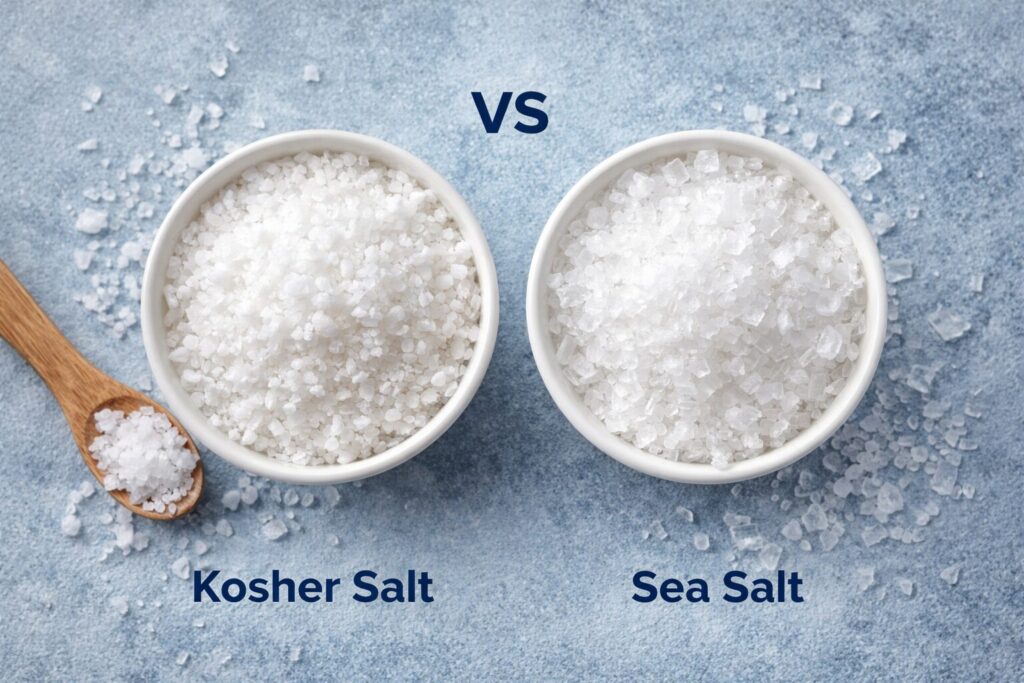
Why People Are Confused About Kosher Salt vs Sea Salt
If salt were as simple as it looks, no one would be searching for answers about it. Yet here we are because once you start cooking regularly, you realize that kosher salt vs sea salt isn’t just a label difference.
Most people notice it when a recipe suddenly tastes too salty or oddly flat. Others notice it when switching salts and wondering why the same measurement doesn’t work anymore. That confusion is fair. These salts behave differently, even though chemically they’re similar.
This article isn’t about trends or “healthier” marketing claims. It’s about how these salts actually function in everyday kitchens.
What Kosher Salt Really Is (Without the Marketing)
Kosher salt was never designed for gourmet cooking. It was used for koshering meat drawing moisture and blood from the surface. That process required salt crystals that were large, flat, and easy to remove.
Those same traits turned out to be useful in cooking.
Kosher salt:
- Is coarse and flaky
- Spreads evenly on food
- Is easy to pinch and control
That’s why professional kitchens rely on it. Not because it’s special—but because it’s predictable.
What Sea Salt Actually Means
Sea salt sounds exotic, but the term itself is broad. All it really tells you is the source: seawater.
Sea salt can be:
- Fine like table salt
- Chunky and coarse
- Dry or slightly moist
The mineral content varies slightly depending on where it’s harvested, but in practice, those differences are subtle. When people debate sea salt vs kosher salt, they’re usually reacting to texture, not nutrition.
Kosher Salt vs Sea Salt: Where the Difference Shows Up
Here’s the honest truth: most confusion comes down to how much salt you’re actually adding, not what kind.
Kosher salt has larger crystals. That means a teaspoon of kosher salt contains less salt by weight than a teaspoon of fine sea salt. So if you swap them one-for-one, the result changes.
That’s why recipes written by chefs almost always specify kosher salt.
Kosher Salt vs Coarse Sea Salt: Much Closer Than You Think
When people compare kosher salt vs coarse sea salt, the gap narrows.
Both:
- Feel crunchy between your fingers
- Work well on roasted vegetables and meats
- Are often used as finishing salts
The difference is consistency. Kosher salt is uniform. Coarse sea salt can vary from brand to brand.
For controlled seasoning, kosher salt still wins.
Coarse Sea Salt vs Kosher Salt in Everyday Cooking
In real kitchens:
- Kosher salt is used during cooking
- Coarse sea salt is often used after cooking
That’s not a rule, but it’s common practice. Texture matters more at the end of a dish than in the middle of it.
Kosher Salt vs Sea Salt vs Table Salt (Where Table Salt Stands Apart)
Table salt is the outlier here.
It’s:
- Very fine
- Highly concentrated
- Often treated with anti-caking agents
When comparing kosher salt vs table salt vs sea salt, table salt is the easiest to overuse. A small amount goes a long way and not always in a good way.
This doesn’t make it “bad,” but it does make it less forgiving.
Why Chefs Stick With Kosher Salt
Chefs don’t choose kosher salt for health reasons. They choose it because:
- It’s consistent
- It’s easy to control
- It behaves the same every time
When seasoning by feel instead of measuring spoons, that consistency matters.
This is why the kosher vs sea salt discussion usually favors kosher salt in professional cooking.
Is Sea Salt Healthier Than Kosher Salt?
Short answer: not really.
Long answer: both are mostly sodium chloride. Trace minerals in sea salt exist, but not in amounts that meaningfully change health outcomes.
If sodium intake is a concern, the type of salt matters far less than how much you use.
What Is Kosher Salt vs Sea Salt Best Used For?
Kosher salt works best when:
- You’re cooking, not finishing
- You need control
- You’re seasoning gradually
Sea salt shines when:
- Texture matters
- The salt stays visible
- You’re finishing a dish
Understanding what is kosher salt vs sea salt comes down to purpose, not preference.
Kosher Sea Salt vs Kosher Salt (Why the Label Gets Confusing)
Sometimes you’ll see “kosher sea salt” on packaging. This usually means sea salt shaped like kosher salt crystals.
It doesn’t change the chemistry it changes the form.
That’s why kosher sea salt vs kosher salt is mostly a sourcing distinction, not a functional one.
When Substitution Causes Problems
Substitution matters most in:
- Baking
- Fermentation
- Pickling
In these cases, crystal size affects precision. Always adjust measurements when switching salts.
Common Salt Myths That Don’t Hold Up
“Sea salt is dramatically healthier.”
Not in practical amounts.
“Kosher salt is less salty.”
Only by volume, not by weight.“Table salt should always be avoided.”
Only excess sodium is the problem.
What’s the main difference between kosher salt vs sea salt?
Texture and measurement behavior.
Can I replace kosher salt with sea salt?
Yes, but reduce the amount if it’s finer.
Is kosher salt better for cooking?
For most people, yes.
What about kosher salt vs coarse sea salt?
They’re similar, but kosher salt is more consistent.
Is table salt interchangeable with either?
Not without careful adjustment.